
Locs: Can You Really Comb Them Out? The Truth, the Process, and What Black Women Should Know
For so many Black women, dread locs are more than a hairstyle — they’re a journey, a spiritual grounding, a cultural anchor, and in many ways, a relationship. Locs grow with us, shift with us, and hold memories in a way loose natural hair never quite does. So when a woman reaches a point where she’s ready for change, the question often comes with a mix of curiosity and fear: “Do I have to cut them off… or can I actually comb them out?”
The short answer is yes — you can comb out locs. The longer, more honest answer is that it’s absolutely possible, but it requires patience, time, and a whole lot of conditioner. Still, more Black women today are choosing this route, thanks to better products, better techniques, and a desire to transition without sacrificing all their length.

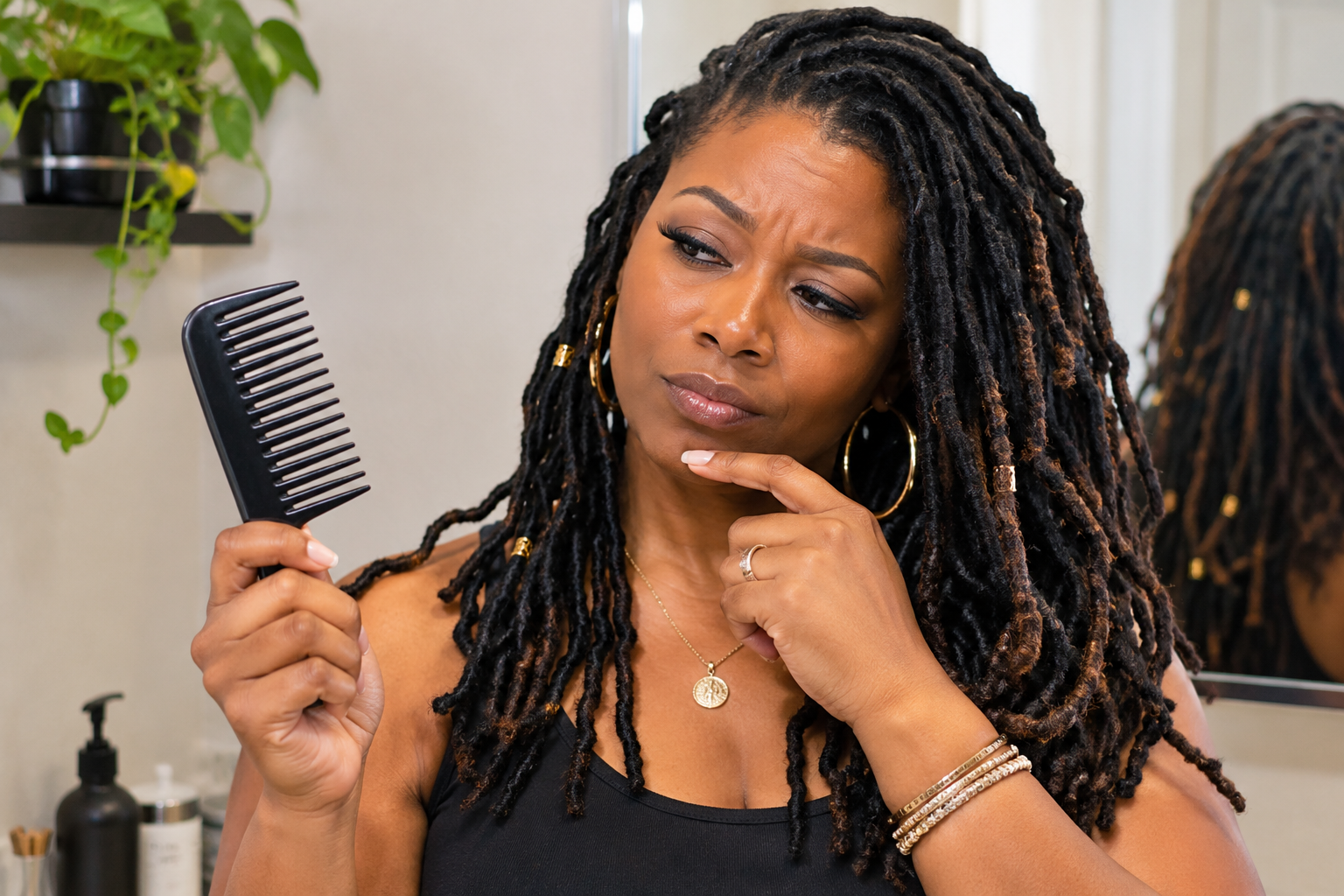
Combing out locs is essentially the reverse of the locking process. Instead of hair intertwining and compacting over time, you’re slowly loosening that compacted structure strand by strand. It’s a delicate process that usually starts with soaking the locs in a mixture of water, conditioner, and oil to soften the hair. From there, a metal rat‑tail comb becomes your best friend — or your worst enemy — as you work from the ends upward, teasing apart years of shed hair and tightly woven strands. Some women finish in a few days. Others take weeks. Some get halfway through and decide the scissors are calling their name. It’s a journey within a journey.
One of the biggest reasons women choose to comb out their locs is the possibility of keeping some length. While you won’t keep every inch, you’ll retain far more than you would with a full big chop. For women who aren’t emotionally ready to go short, this option feels gentler and more empowering. The process also gives you an intimate look at your hair’s true texture, density, and health — something many women haven’t seen in years. And for some, the act of taking down locs is deeply symbolic, marking a new chapter or a personal transformation. Many even choose to loc again later, this time with more clarity about what they want.
But let’s be real: combing out locs is not glamorous. It takes forever. If patience isn’t your ministry, this may not be your calling. You will lose hair — sometimes a shocking amount — because locs hold onto every shed strand. Your ends may be weak or thin after years of being compacted, and trimming is often necessary. The emotional weight can also be heavy. Locs carry memories, and unraveling them can feel like saying goodbye to a version of yourself. And depending on the age, size, and health of your locs, you may need professional help to get through the process without damaging your hair.
So who is combing out locs really for? It’s ideal for women who want to preserve length, who have the time and patience to commit to the process, and whose locs are in reasonably good condition. If your locs are extremely mature, very small, or severely damaged, cutting may still be the healthier and more realistic option.
Still, the growing number of women choosing to comb out their locs shows how much our relationship with hair continues to evolve. Black women are exploring new ways to honor their hair journeys without feeling boxed into one path. Combing out locs isn’t easy, but it’s absolutely possible — and for many, it’s empowering. Like everything in Black hair culture, the decision is deeply personal, rooted in identity, and shaped by where you are in your life.
💬 Your Turn — BlackHairMedia.com Community Check-In
Have you ever combed out your locs, or would you consider it? What was your experience — or what’s holding you back? Share your story on the forum and with the community using #BHMUnLocYourStory so we can learn from each other and support every stage of the journey.